Thursday, May 29, 2014


Tuesday, March 23, 2010
Successful! Thanks everyone!
We raised our money for the pilot and are working on it now. Thanks to all our backers...

Monday, February 1, 2010
Saturday, January 17, 2009

Saturday, January 10, 2009

Wednesday, November 26, 2008
Going to 3-D Summit!
We'll be at the 3-D Summit Monday, Dec. 1st if anyone's interested in meeting up drop us a line!
SPLIT GRAPHICS & STAGGERED FADE TEST "SEA MONSTER" nonHD from Daydream Glacier on Vimeo.
Sea Monster - the New Stereo Expressionism- nonHD version from Daydream Glacier on Vimeo.
Here's more tests-- this one has a breakdown of the left-right split at the end to clarify what we're doing.
Watch below with your red-cyan 3D glasses or watch in HD here:
SPLIT GRAPHICS & STAGGERED FADE TEST "SEA MONSTER" nonHD from Daydream Glacier on Vimeo.
and here's the last post's clip, a.k.a. the "left eye flashback" test (here in HD)
Sea Monster - the New Stereo Expressionism- nonHD version from Daydream Glacier on Vimeo.
Saturday, November 22, 2008
...A Certain Tendency in Stereoscopic 3D Cinema...

Stereo Expressionism and the New 3D Grammar in Gray Miller's "Sea Monster"
At the beginning of cinema, the pioneers of the early twentieth century art form invented a new language and grammar for film. Close-ups, cross-cutting between parallel stories, POV shots, and the repetitive edits of Eisenstein were developed as artists realized that psychological subjectivity was more important than actual reality in the construction of stories with moving images.
In 1960's "Breathless", Jean Luc Godard created a stir with the addition of jump cuts, a new tool in the toolbox of film grammar. Now almost ubiquitous in handheld indie dramas, jump cuts had existed before 1960 only as accidents in damaged film prints, or the cut of last resort in poorly edited films that didn't have the coverage for seamless editing. JLG was the first to see jump cutting as a storytelling tool that fit the emotional space of his films, and the energy and distraction of their youth.
The resurgence of 3D can begin a new chapter in film grammar.
There is so much more storytelling and film grammar potential. Forget about depth for a moment. Think about juxtaposition and association, and your audience's ability to hold two images in their head that are both visible, but neurologically and optically separate. Understandably, the initial goal of every technology is the perfect imitation of "reality". But what we experience, especially in the art of cinema, is subjective and emotional. And here we have tools that allow us to design coordinated but potentially juxtaposed imagery and storytelling for EACH EYE of the audience.

So I tried it.
 ---
---
New technology exists, and the industry is drooling over the boost 3D gives ticket sales, but no one seems to be really thinking about rethinking the new form. With the exception of some beautiful layered graphics in the U23D concert film, the formula for the 21st Century 3D Cinema seems to be concentrated, for understandable reasons, on technical perfection of the depth effect.
There is so much more storytelling and film grammar potential. Forget about depth for a moment. Think about juxtaposition and association, and your audience's ability to hold two images in their head that are both visible, but neurologically and optically separate. Understandably, the initial goal of every technology is the perfect imitation of "reality". But what we experience, especially in the art of cinema, is subjective and emotional. And here we have tools that allow us to design coordinated but potentially juxtaposed imagery and storytelling for EACH EYE of the audience.
Get a pair of red-cyan 3D glasses and look at the image below. Close your left eye, then your right, to see the separation. If you can't find a place for glasses, email us and we'll mail you a pair free--
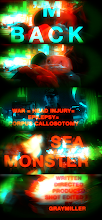
Flashbacks no longer have to be cut to-- you can send the flashback to the left eye while watching the character's reaction in your right eye. The protoganist featured in the excerpt below from my film "SEA MONSTER" has undergone split-brain surgery in an attempt to control her epilepsy. Her seizure is indicated by a sudden switch from smooth 24fps 3D in both eyes to a blurry Chungking Express style 4fps in the right eye while perfectly crisp 24 fps in the left eye. For intertitles, the first half of a phrase is placed in the left eye and the second complimentary half in the right eye. My characters left/right disorientation is conveyed through fade outs that cascade across your brain as the left eye goes dark, then the right eye, and staggered overlapped cuts that showed you the next shot a few frames earlier in one eye than the other.
But I know, theorizing is easy, filmmaking is hard.
So I tried it.
And it works.
Again, to really understand the 3D and what we're doing with Stereo Expressionism, and see the separate elements of the storytelling, you need to get a pair of red-cyan 3D glasses to look at the clip below. Watch it once with the glasses, once with your left eye closed, and once with your right eye closed to see the separate elements. If you can't find glasses email us and we'll send a pair for free.
You can watch below or watch it here in HD:
.
It's something 3D has never done before. It's, frankly, a whole new way of thinking about the artist's approach to the 3D toolbox for storytelling. Stop thinking about the depth and start thinking about storytelling grammar for two eyes.
You can call it the New 3D Grammar, Stereo Expressionism, or if you like, Gray Miller's weird Sea Monster Web Series noodling/sketchpad...
but you can see the first clip/test here in HD, if you don't see it above,
You can call it the New 3D Grammar, Stereo Expressionism, or if you like, Gray Miller's weird Sea Monster Web Series noodling/sketchpad...
but you can see the first clip/test here in HD, if you don't see it above,
and we'll have full episodes up starting in 2009.
Contact Me
Get ahold of some red-blue 3D glasses, and get ready for
Get ahold of some red-blue 3D glasses, and get ready for
SEA MONSTER.
---postscript, on "Getting It"
I know it's difficult to explain the 3D features of the images and clip above when most of you don't have 3D glasses.
At the simplest level-- if you're NOT wearing 3D glasses, the blue little girl footage just looks superimposed over the woman laying on the ground. But if you were wearing 3D anaglyph glasses, you would see the little girl flashback ONLY in your left eye, simultaneously seeing the woman on the ground ONLY in your right eye. And vice versa for the red "war" footage.
If a split-brain patient was watching the clips above with 3D glasses, and you asked her what she saw, she'd say "I saw a woman having a seizure and then that faded out and I saw some war footage". No mention of the little girl. But if you asked her to draw with her left hand what she saw, she'd draw a little girl and then a woman having a seizure, with no drawing of the war footage. The images are separate. Our brains are assembling them.
Up until now, you've only had two film grammar choices for combining images to tell stories:
1. Intercutting between two images via editing.
2. Superimposing two images via fx/opticals/splitscreens
Now you have 3: Juxtaposing imagery in the audience's brain by sending one image to their left eye and a separate image to their right, using 3D technology for a new storytelling function apart from depth simulation.
By necessity, I've had to conduct these tests with inexpensive cameras and homebrew rigs, and show them in red-cyan anaglyph. With professional level equipment that gets better convergence and professional projectors that don't require red-blue fringing, the effect would be even more unique and pronounced.
Thanks and hope to post more clips soon!
Subscribe to:
Posts (Atom)

 Posts
Posts